
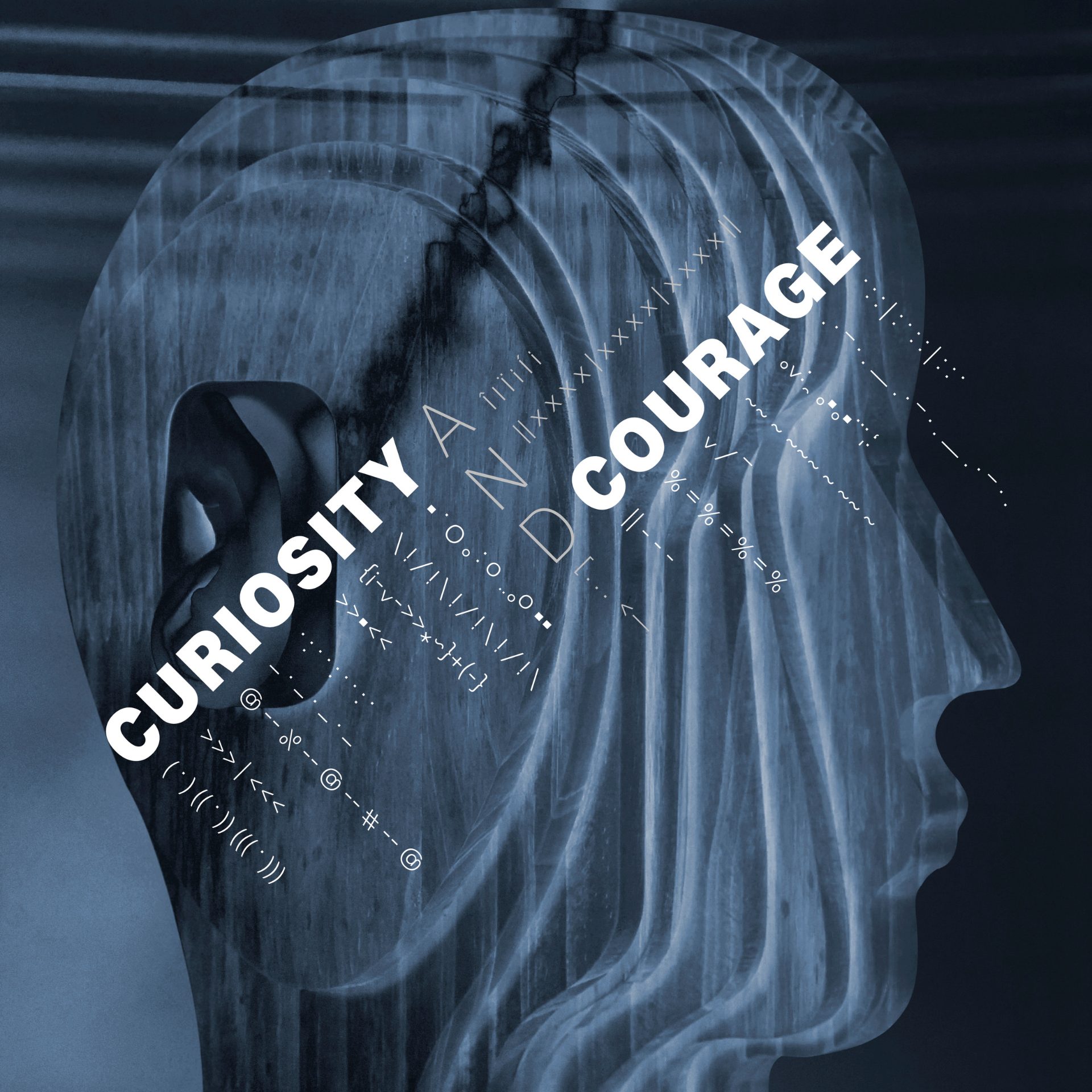
“Curiosity and Courage”
PGVIS 2026 — DAILY HIGHLIGHTS
18–22 August 2026
This year, PGVIS invites audiences to move through a series of questions: from curiosity, to the courage to cross boundaries; from taking risks and finding other paths, to asking what music might yet become.
Here are some of the ideas, people and performances shaping each day.
WED 19 AUG — THE COURAGE TO GO BEYOND
How far are we prepared to follow our curiosity?
The first full day of PGVIS begins with Sean Gregory of Guildhall School of Music & Drama, who approaches the ensemble not simply as a group of musicians, but as a space for listening, encounter and possibilities that cannot always be planned in advance.
Nathan Riki Thomson of the Sibelius Academy, University of the Arts Helsinki takes that conversation beyond the concert platform through Global Artistic Citizenship, asking what musicianship might mean when artists engage with different cultures, communities and a rapidly changing world.
Then Jeroen Malaise of Royal Conservatoire Antwerp turns toward the past in search of another way forward. In The Art of Preluding, he revisits a form of improvisation once embedded in the everyday practice of classical musicians — and now waiting to be rediscovered.
Performance opens still more routes across familiar boundaries.
Usa Napawan x Lalita Bay Jantaro bring piano and Spanish dance together in Alma Y Pasión, while Saksri Vongtaradon repositions the story of Hanuman and Suphannamatcha from the Ramakien through dance, film, live electronics, motion tracking and real-time video.
By evening, collaborations involving Seathencity, Seoul National University (SNU) and PGVIM move between musical cultures, improvisation and audience participation, before NISATIWA — Tontrakul Kaewyong x Narisara Sakpunjachot x PGVIM close the day with RUNG ARUNN — “dawn,” poised between what is already known and what has yet to arrive.
Perhaps the question for 19 August is not simply “What are we curious about?”
But rather:
“If we are truly curious, how far are we willing to go?”
THU 20 AUG — TAKING THE RISK
If the first day asks us to step beyond familiar territory, the second raises a more difficult question:
How much control are we prepared to give up?
Lies Colman of the Royal Conservatoire The Hague begins with a title that gets straight to the point:
The Risk of Playing It Safe
In a musical culture built around preparation, mastery and the reduction of error, Colman turns our attention toward uncertainty, vulnerability and the unpredictable — not necessarily as failures of performance, but as conditions through which discovery may become possible.
Jean Geoffroy of CNSMD Lyon then expands the question from the individual performer to collective creation: as contemporary artistic work becomes increasingly collaborative and interdisciplinary, how much space do our institutions really make for experimentation together?
In the evening, PGVIS moves to Marshall Livehouse for Curiosity in Resonance.
At the centre of the programme is David Tudor’s Rainforest, where sound passes through transducers into physical objects, allowing the resonant properties of each material to become part of the work itself.
The project brings together artists from Hochschule der Künste Bern, University of Music Lübeck, PGVIM and Studio Musikfabrik, with Peter Veale, Teresa Carrasco and Nicola Leonard Hein playing key roles in shaping the project and performance environment.
Around Rainforest, a wider programme performed by Studio Musikfabrik moves through acoustic resonance, percussion, oboe, electronics and changing relationships between performers, objects and technologies.
The evening does not “illustrate” the discussions of risk that came before it. But placed side by side, they open a related question:
What happens when musicians stop deciding everything in advance — and allow material, space, technology and other people to participate in the outcome?
FRI 21 AUG — THE ARTIST AS CITIZEN
By Friday, the focus begins to move from
“What kind of artist do I want to become?”
toward
“How does an artist live and act in relation to others?”
Bernard Lanskey of Queensland Conservatorium Griffith University looks back into conservatoire culture through the experiences of women finding their own artistic identities and pathways within structures that may not accommodate everyone in the same way.
Vichaya Mukdamanee of Silpakorn University extends the discussion toward the artist as Global Citizen — asking what happens when artistic practice enters collaboration, community and wider social processes rather than ending with the production of an artwork.
Keld Hosbond of the Royal Academy of Music Aarhus/Aalborg brings the question into education through Value-based Education and Artistic Citizenship: if musicians are being prepared for an increasingly complex and fast-changing world, what values should sit at the centre of music education today?
And Anant Narkkong of Silpakorn University proposes Curatorial Ethnomusicology, moving the ethnomusicologist beyond the documentation of musical cultures toward the deliberate creation of conditions in which new musical encounters, participation and knowledge can emerge.
The evening programme, Into Possibilities, opens several more pathways. Jeroen Malaise returns, now through a masterclass showcase developed around The Art of Preluding — allowing an idea introduced earlier in the symposium to become something musicians practise for themselves.
In Aural Breakthroughs through Folk Music, PGVIM collaborates with Yong Siew Toh Conservatory, with Karst de Jong among the project’s mentors. Instead of beginning with notation, the project learns from Thai folk traditions through memory, listening and oral transmission — asking what music education might look like when the score is no longer the starting point.
And the night does not end there.
For Those Who Dared: Experiments Across Generations marks György Kurtág’s 100th year by placing works from Játékok and Signs, Games and Messages alongside music and performance practices of composers working today.
Artists from Seoul National University (SNU), Studio Musikfabrik, University of Music Lübeck, HKB and PGVIM move from Kurtág toward solo percussion, audiovisual work, electronics, improvisational structures and human–machine systems.
Among the evening’s works is Nicola Leonard Hein’s Tertiary Protentions II — For Guitar and Musical Agent System, in which electric guitar interacts in real time with a musical agent system.
Experimentation, here, is not treated as the property of one generation.
It can be inherited, questioned, transformed — and passed on.
So perhaps 21 August leaves us with this:
What have we inherited from those who came before us — and where are we prepared to take it next?
SAT 22 AUG — WHERE MIGHT MUSIC GO NEXT?
The final day begins directly with AI.
But the question is larger than whether AI can compose music, or whether machines will replace musicians.
Li Xiaobing of the Central Conservatory of Music, Beijing introduces Machinism, asking what happens to ideas of creativity, agency and even the conservatoire itself when artificial intelligence becomes increasingly involved in artistic creation.
Nicola Hein of the University of Music Lübeck approaches the subject through Cybernetic Listening and Human–Machine Improvisation. Rather than asking which side controls the other, Hein considers how agency might emerge between human and machine as both listen, respond and change in real time.
Another perspective comes from Thanakrit Lerdmatayakul of the Skolkovo Institute of Science and Technology (Skoltech) Russia, asking:
Can a Machine Learn Thai Musical Grammar?
Rather than presenting AI as an autonomous composer, his research uses computational modelling to examine what a machine can learn from a corpus of Thai classical music — and, just as importantly, where its understanding reaches its limits.
Lamtharn Hanoi Hantrakul of Mayura Labs continues the conversation with AI Music — What Happens When We Get There?
The question is no longer simply whether AI music will arrive.
It becomes:
What do we do once it has?
The afternoon AI & Immersive Arts Course Showcases take these ideas out of the discussion room and into interactive installations, live coding, visual systems and audience participation.
Technology is no longer only backstage. It becomes medium, collaborator and environment.
And after spending much of the day discussing possible futures, PGVIS does not end by disappearing into AI.
Instead, it opens the doors wider.
OPEN EARS, OPEN DOORS — MUSIC INDUSTRY NEXUS
The final evening feels like the conservatoire opening both its doors and its ears to the musical worlds already moving around it.
PELA Folk, Rowena Calvert, Supergoods, GYPSHA, B35, SUN DER, INSPIRATIVE, Montonn Jira and The Superglasses Ska Ensemble bring together Thai folk, experimental classical, neo-funk, world music, contemporary jazz, contemporary Isan, post-rock, ambient and ska — a live snapshot of a musical ecosystem that refuses to fit a single definition of “contemporary music in Thailand.”
Alongside the artists, L.U.N. — Live Unit Network gives emerging music professionals direct experience in artist relations, production, stage management, sound, communications and the many forms of work that make live music possible.
It feels like an appropriate place to end.
Because after four days of asking
“What should the conservatoire of the future become?”
perhaps not every answer will be found inside the conference room.
Some may begin by opening the doors, opening our ears, and listening to what is already happening beyond them.
Across four days, the journey might be summed up like this:
19 August — How far are we willing to go?
20 August — What are we willing to risk?
21 August — What other paths might we take?
22 August — Where might music go next?
No one needs to leave PGVIS with answers to all four.
A new question, a sound you had not encountered before, or a conversation that shifts something you thought you already knew may be more than enough.
Come and be curious. Come and be courageous.
PGVIS 2026 — Curiosity & Courage
18–22 August 2026
Princess Galyani Vadhana Institute of Music, Bangkok
#PGVIS2026#CuriosityAndCourage#PGVIM
19 August — How far are we willing to go?
20 August — What are we willing to risk?
21 August — What other paths might we take?
22 August — Where might music go next?